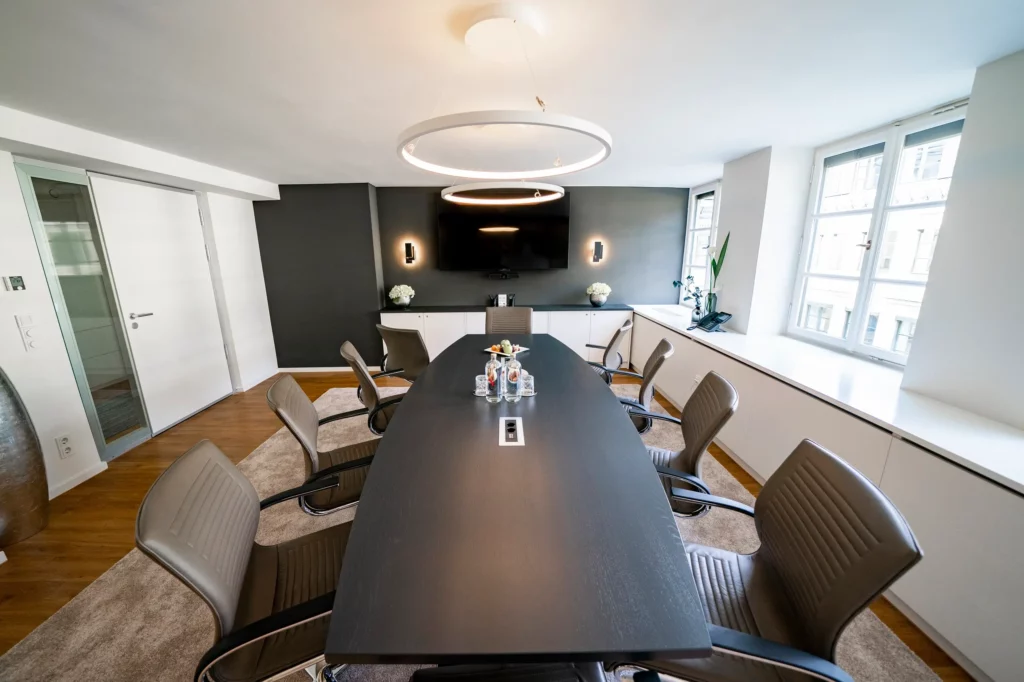
Finding a Conference Room in Berlin: 7 Criteria for Making the Right Choice


A conference room is more than just a location with the right number of seats. It influences how focused people are while working, how professional a company appears, and how smoothly a meeting goes.
Anyone looking to want to rent a conference room in Berlin shouldn’t base their decision solely on location, size, or price. A confidential one-on-one meeting places different demands on a room than a workshop, a hybrid board meeting, or a training session lasting several hours. Seating arrangements, acoustics, technology, service, and booking terms can also be crucial to the success of the event.
The most important question, therefore, is not: Which room looks the best?
But rather: What conditions does this meeting need to achieve its goal?
These seven criteria will help you choose a conference room in Berlin that suits your event, your guests, and your work style.
Table of Contents
- Define the Purpose and Format of the Meeting
- Choose the right location in Berlin
- Determine the room size and seating arrangement
- Check the technology for presentations and hybrid meetings
- Pay attention to acoustics, concentration, and privacy
- Plan for service and catering
- Compare services and booking terms
1. Define the purpose and format of the meeting
Before you compare locations or check the number of participants in room schedules, you should have a clear goal for the event. After all, a room that’s ideal for a presentation doesn’t necessarily meet the right requirements for a workshop or a confidential conversation.
First, clarify the following:
- What should the outcome be at the end of the meeting?
- How many people will be participating in person and online?
- Will the focus be mainly on presentations, discussions, or collaborative work?
- Will flexible workspaces or a fixed seating arrangement be needed?
- How confidential is the event?
- What impression should the space make on customers, job applicants, or business partners?
A board meeting or contract negotiation typically requires a quiet room with a clear seating arrangement and a high level of confidentiality. Workshops, on the other hand, require freedom of movement, flexible seating, and spaces where ideas can be developed visibly. For hybrid meetings, the focus shifts to acoustics, camera positioning, and easy-to-use video conferencing.
The composition of the participants also plays a role. For an internal coordination meeting, a functional setting may suffice. When hosting important clients, investors, or international business partners, the location, architecture, reception, and service all contribute to a professional image.
The choice of room should therefore always be based on the meeting’s objective—not the other way around.
Our guide to creative meeting rooms in Berlin.
2. Choose the right neighborhood in Berlin
A central location is only a good choice if it is convenient for the actual participants. What matters is not just the distance to the city’s geographic center, but its accessibility in the specific business context.
Therefore, check the following:
- Where are the participants traveling from?
- Will they be traveling by train, plane, public transportation, or car?
- Are the client’s office, hotel, or event venue nearby?
- Are multiple appointments scheduled for the same day?
- Will a restaurant, reception, or additional business meeting be needed after the meeting?
For guests from different parts of Germany, good access to the main train station can be a deciding factor. For international participants, the travel routes from the airport to suitable hotels should also be taken into account. If the event takes place near government ministries, associations, or law firms, Berlin-Mitte is often a good choice. For companies associated with the trade fair, City-West, or the western part of Berlin, a location on Kurfürstendamm may be more convenient.
The address itself also sends a message. For an important meeting with a client or a meeting with management, a prestigious building can underscore the professional setting. It is no substitute for thorough preparation, but it does influence the first impression—even before the actual conversation begins.
For events lasting several days, it’s also worth checking out the immediate surroundings. Short distances between the conference room, hotel, and evening activities make planning easier and give participants more time to enjoy the event itself.
3. Determine the room size and seating arrangement
The maximum number of people is only a rough guide. A room may seem large enough on paper but still feel too cramped if additional equipment, catering, work materials, or space to move around are needed.
Therefore, don’t base your planning solely on the number of seats. Also consider:
- the desired seating arrangement,
- unobstructed view of presentation areas,
- space for moderation and group work,
- space to move around between work phases,
- Storage options for documents and equipment,
- Areas for beverages or catering,
- sufficient spacing for longer events.
The appropriate seating arrangement depends on the type of activity:
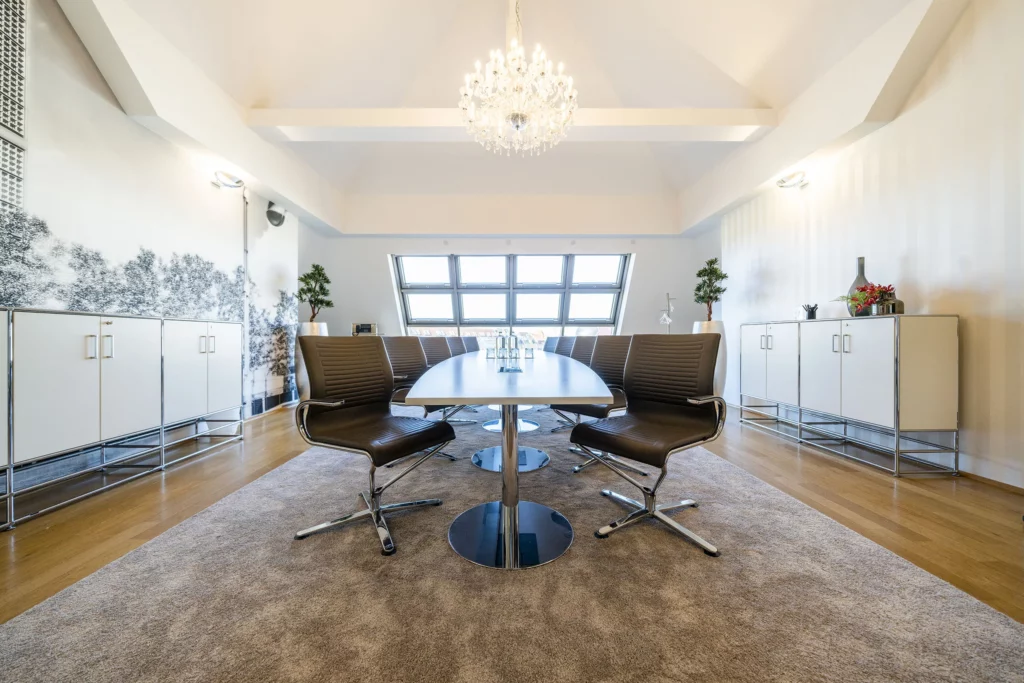
Block or Boardroom Seating
It is suitable for structured meetings, decision-making sessions, contract negotiations, and traditional conferences. All participants sit at a shared table and can easily access documents or use their devices.
U-shape
This layout provides a clear view of presentations while also leaving room for interaction. It is particularly well-suited for workshops, training sessions, and moderated discussions.

Flexible Seating Arrangements
Workshops and creative work formats benefit from a room layout that can be adjusted during the session. This makes it easier to combine small groups, presentations, and collaborative work sessions.

Lounge Setting
For coaching sessions, confidential conversations, interviews, or one-on-one client meetings, a less formal seating arrangement may be appropriate. It fosters a sense of closeness without compromising the professional setting.
For longer meetings, it’s best to allow for a little more space. Cramped conditions become more noticeable as the meeting goes on and can impair concentration and the flow of the conversation.

4.Checkthe technology for presentations and hybrid meetings
Technical problems don’t just cost time. They disrupt concentration, make it harder to facilitate the meeting, and can quickly come across as unprofessional to customers or business partners.
The equipment required depends on the format. For an internal meeting, a presentation display may suffice. For a hybrid conference, however, the camera, microphones, speakers, internet connection, and room acoustics must all work together seamlessly.
Clarify the following before booking:
- What presentation system is available?
- What connectors and adapters are needed?
- Can personal devices be easily connected?
- Is there a wired LAN connection and stable Wi-Fi?
- Is a video conferencing system permanently installed?
- Are the camera and microphones suitable for the size of the room?
- Can everyone in the room be seen and heard clearly?
- Can external participants join via the desired platform?
- Is a technical check offered before the event begins?
- Is there a contact person on site available in case of problems?
With hybrid formats, it’s not enough to simply place a laptop on the table. An unfavorable camera position, echo-prone rooms, or microphones that are too far away make it difficult for digital participants to follow the conversation. Therefore, make sure not only that video conferencing equipment is available, but also that it is suitable for the planned number of participants and seating arrangement.
Additional resources should also be coordinated well in advance. These include, for example, whiteboards, flipcharts, facilitation kits, projectors, or large-scale visualization tools.
5. Pay attention to acoustics, concentration, and discretion
Location, design, and technology are visible. The acoustic quality of a room, on the other hand, is often only noticed when it’s not right.
Street noise, voices from adjacent areas, long reverberation times, or frequent interruptions can impair concentration. In the case of confidential conversations, it’s also important that the content not be overheard by others.
Therefore, pay attention to the following points:
- Is the room acoustically separated from the rest of the workspace?
- Can conversations be heard from hallways or adjacent rooms?
- Are the acoustics suitable for video conferences?
- Can the door remain closed during the meeting?
- Is there sufficient privacy for sensitive content?
- Are larger events taking place nearby at the same time?
- Is the room comfortable to use even over the course of several hours?
Discretion should not be viewed as an additional service, particularly during board meetings, performance reviews, contract negotiations, coaching sessions, or legal consultations. It is one of the fundamental requirements for the space and the service.
The design can also help promote concentration. Subdued colors, high-quality materials, good lighting, and a clear spatial layout reduce visual distraction. A professional conference room doesn’t have to feel cold—but it should support the meeting’s agenda rather than compete with it for attention.
6. Plan for Service and Catering
A well-prepared room makes things easier for the host. This is especially true when hosting clients, executives, or larger groups.
Clarify in advance which services are included in the offer and which can be booked as add-ons:
- Setting up the room with the desired seating arrangement,
- Welcoming and escorting guests,
- Providing name tags or handouts,
- Serving beverages,
- Breakfast, lunch, or refreshments during breaks,
- Support during the event,
- Assistance with last-minute changes,
- discreet service during confidential meetings.
When it comes to catering, it’s not the widest possible selection that matters, but rather how well it fits the schedule. For a brief meeting, water, coffee, and tea are often sufficient. For a full-day workshop, clearly scheduled breaks and light refreshments help maintain focus.
Be sure to take food intolerances, dietary preferences, and international guests into account. This information should be provided to the caterer in a timely and organized manner.
The way the service is provided is also important. During a high-stakes business meeting, the service staff should be attentive and reliable, but should not draw attention to themselves. Good service is most evident when it allows the host to focus on their guests and the meeting’s agenda.
7. Compare Services and Booking Terms
The listed hourly rate alone says little about the actual costs. What matters is which services are included and which items are billed separately.
So be sure to compare:
- Minimum booking duration,
- hourly, half-day, or full-day rates,
- Equipment included,
- Costs for additional equipment,
- Surcharges for catering and service,
- bookings outside regular business hours,
- Setup and takedown times,
- Setup changes during the event,
- cancellation policies,
- Options for short-notice extensions.
Also, check whether the reserved time slot covers only the actual event or whether it must already include setup, technical testing, and the arrival of guests. An event that begins at 10 a.m. usually requires earlier access to the room.
For more complex events, it is advisable to have a written plan. This plan should outline the seating arrangement, technical setup, catering, points of contact, and schedule. This helps prevent misunderstandings and makes it easier to coordinate last-minute changes.
The cheapest venue is not necessarily the most cost-effective solution. If technology, reception, refreshments, and staff must be arranged separately, what initially seems like a low price can actually result in significant internal effort.
Conference Rooms at Satellite Office in Berlin
Satellite Office offers conference and meeting rooms at four locations in Berlin: at Kurfürstendamm 15 and 194, Unter den Linden 10, and at Französische Straße 12.
The offerings range from day suites and secluded fireplace lounges to traditional conference rooms and flexible workshop and event spaces. This provides a variety of settings for confidential discussions, client presentations, workshops, seminars, hybrid conferences, and larger events.
The technical equipment in selected rooms includes, among other things, video conferencing systems, presentation displays, and Internet access via LAN and Wi-Fi. Whiteboards, flipcharts, facilitation materials, and other presentation equipment can be provided as needed, depending on the room and requirements.
Upon request, the team can assist with setting up the room, welcoming guests, and arranging for beverages or catering. Rooms can be reserved flexibly for individual hours or entire event days.
The pureSilent® space concept combines understated architecture, high-quality materials, and acoustically optimized workspaces. This creates a professional environment that facilitates both focused collaboration and face-to-face interaction.
Conclusion: The right room depends on the purpose of the meeting
A suitable conference room doesn’t have to be as large as possible, flashy, or overloaded with technology. It must be appropriate for the occasion.
First, define the objective, the group of participants, and the format. Then review the location, room size, seating arrangement, technology, acoustics, service, and terms and conditions. The more precisely these factors are coordinated, the fewer organizational hiccups there will be on the day of the event.
Are you planning a meeting, a workshop, a conference, or a client meeting? Discover the conference rooms in Berlin and find the perfect setting for your meeting.
Stay up to date
Subscribe to our newsletter

Subscribe to our free newsletter and receive regular updates from the world of Satellite Offices. Find out all about exciting events, innovative products, special offers and the latest developments at our locations.