Renting Office Space in Germany in 2026: A Comparison of the Top 7 Office Locations


Berlin, Düsseldorf, Frankfurt, Hamburg, Cologne, Munich, or Stuttgart: Anyone looking for an office in one of Germany’s major economic hubs in 2026 will encounter a contradictory market. Vacancy rates have risen in many places—yet high-quality, modern space in sought-after downtown locations remains scarce.
Of the available space in Germany’s seven largest office markets, only 14 percent is located in buildings completed since 2020. A large portion of the vacancy is therefore attributable to older, lower-quality, or less sought-after spaces.
For companies, it is therefore not enough to simply compare prices per square meter and vacancy rates. The economically more relevant question is:
What location and quality do we actually need—and is it worth it to lease our own long-term office space or opt for a ready-to-move-in flexible office?
After all, actual office costs result from the interplay of:
- City and Micro-Location
- Building Quality
- Required Area
- Finishes and amenities
- Operating and utility costs
- Services and Infrastructure
- Internal administrative overhead
- Contract term and flexibility
This guide compares the seven most important German office markets and shows in which business scenarios a traditional office lease or a high-quality flexible office might be the best choice.
Germany’s Top 7 Office Markets in 2026
| City | Leased Area, H1 2026 | Average Rent, Total Market | Top Rent | Vacancy rate |
| Berlin | 367,800 m² | 28.20 €/m² | 50.90 €/m² | 9,5 % |
| Düsseldorf | 101,000 m² | 21.90 €/m² | 45.00 €/m² | 11,4 % |
| Frankfurt | 152,100 m² | 28.50 €/m² | 56.00 €/m² | 12,8 % |
| Hamburg | 189,400 m² | 22.00 €/m² | 38.00 €/m² | 6,2 % |
| Cologne | 72,000 m² | 20.00 €/m² | 33.00 €/m² | 5,5 % |
| Munich | 350,900 m² | 26.85 €/m² | 62.00 €/m² | 10,2 % |
| Stuttgart | 55,600 m² | 17.90 €/m² | 37.00 €/m² | 7,0 % |
Source: Standardized Top 7 Market Survey, H1 2026. All rental rates are net per square meter per month for conventional office leases. Additional methodological notes are provided at the end of the article.
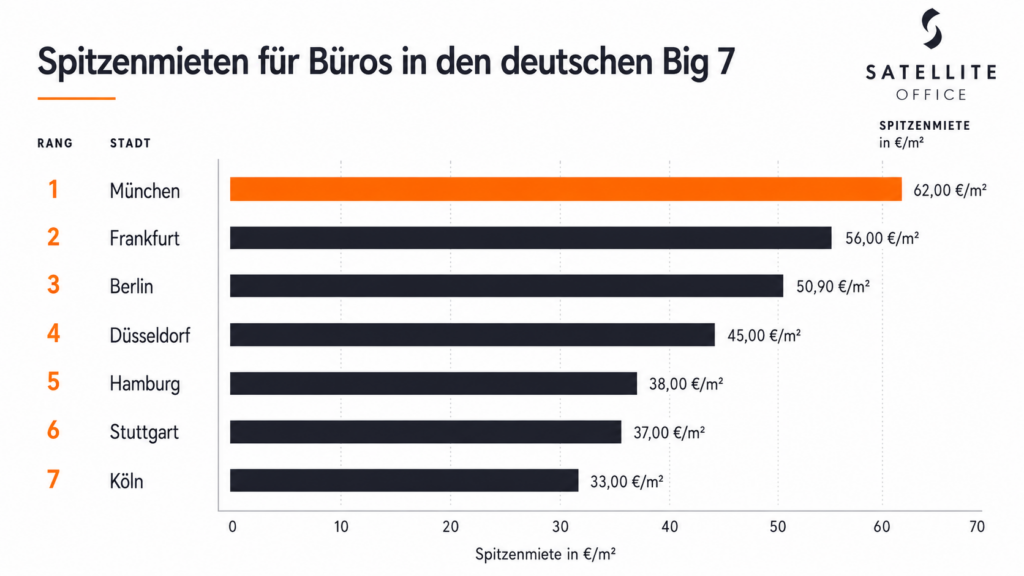
At this top-tier level, Munich is thus nearly 30 euros per square meter per month more expensive than Cologne. However, it is not yet possible to determine which city is actually more economical for a business.
More Vacancies—But Still a Shortage of Premium Space?
Frankfurt has a total vacancy rate of 12.8 percent, Düsseldorf 11.4 percent, and Munich 10.2 percent. At the same time, these cities are among the most expensive German office markets.
The reason: vacancy does not necessarily equate to available high-quality space.
Companies are increasingly focusing their demand on modern, high-quality, well-connected, and energy-efficient buildings. In Berlin, Frankfurt, and Munich, more than 40 percent of the space leased over the past 18 months consisted of particularly high-quality space.
The difference becomes particularly clear when looking at the city centers:
| City | Vacancy Rate for the Overall Market | Vacancy Rate in the City Center/CBD | Average Rent in Central Areas | Top Rent |
| Berlin | 9,5 % | 8.6% | 31.88 € | €46.50–50.90 |
| Düsseldorf | 11,4 % | 9.3% | €32.44 | €45–46 |
| Frankfurt | 12,8 % | 8.1% | 38.78 € | 55–56 € |
| Hamburg | 6,2 % | 4.1% | 27.87 € | 38–41 € |
| Cologne | 5,5 % | – | – | 33–33.50 € |
| Munich | 10,2 % | 1.7% | 43.65 € | 62 € |
| Stuttgart | 7,0 % | – | – | 37 € |
Source: Overall market for H1 2026 and supplementary local market reports. Definitions of “downtown” and “CBD” vary by provider and are therefore only comparable to a limited extent.
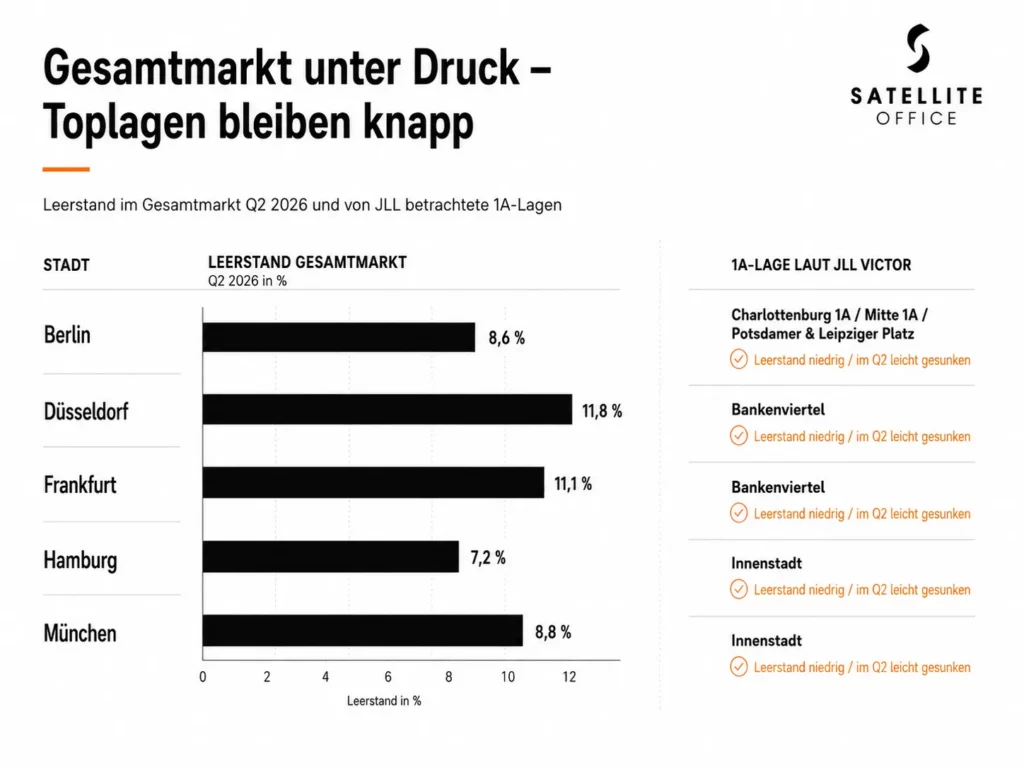
Munich, in particular, illustrates how the market works:
10.2% vacancy rate in the overall market—only 1.7% in the city center.
The key takeaway:
A high vacancy rate does not automatically make a city an affordable option. The key factors are the submarket, building quality, floor area, and lease model.
Which office model suits which company?
A company with four employees has different requirements than a headquarters with 200 workstations. That’s why the question of which office model to choose should be addressed early on.
| Company Situation | Traditional Lease | High-Quality Flexible Office |
| New Branch Office | High initial investment and early commitment | very fitting |
| Branch office with 1–10 employees | Own space quickly becomes too large | very fitting |
| Law firm or consulting firm with client traffic | Quite possible | Particularly attractive in prime locations |
| Entry into the international market | Long-term space decisions must be made early on | very fitting |
| Project team for 6–24 months | often too inflexible | very fitting |
| Management / Regional Office | In-house infrastructure can be inefficient | very fitting |
| Fluctuating staffing needs | Adjustments Are Time-Consuming | Suitable |
| Large team with stable, long-term staffing needs | Often a good fit | Check on a case-by-case basis |
| Corporate Campus / Specialized Expansion | Clearly suitable | Less suitable |
Flexible premium offices are particularly appealing in situations where space requirements are modest, but expectations regarding location, work environment, and professionalism are high.
This applies, for example, to corporate representative offices, law firms, consulting firms, investment companies, family offices, executive teams, international branches, and project companies.
When does it make more sense to have your own space?
A traditional lease may be more cost-effective if large teams work permanently at a single location, space requirements can be reliably planned over many years, or a fully customized corporate architecture is to be implemented.
As a rule of thumb:
The larger and more stable the space requirement and the longer the planning horizon, the more economically viable it becomes to have dedicated space. Conversely, the higher the demands on location and infrastructure—combined with a manageable or variable space requirement—the more attractive flexible office solutions become.
Small premium spaces constitute a market of their own
The overall vacancy rate masks another important distinction.
A company with four employees isn’t interested in how many hundreds of thousands of square meters of office space are available in Munich or Frankfurt in total.
What matters is:
What high-quality, move-in-ready, and prestigious space for four to eight people is actually available at the desired address?
A vacant 500-m² property does little to solve this problem, nor does an inexpensive office on the outskirts of town, if you regularly meet with clients and need a central office location.
For smaller, discerning teams, therefore, it is not the overall vacancy rate that matters, but rather the availability of suitable small and medium-sized units in the desired quality segment.
The Top 7 in a Sentence
| City | Key Message |
| Berlin | Wide selection—microlocation and the building itself are particularly important factors. |
| Düsseldorf | Königsallee is a prime example of the value of a premier address. |
| Frankfurt | A high overall vacancy rate in the Financial District does not automatically mean affordable premium office space. |
| Hamburg | High-quality, smaller downtown spaces remain relatively scarce. |
| Cologne | Prices are more moderate, but there is no oversupply of modern, high-quality small spaces. |
| Munich | The highest rent levels and an extremely limited supply of downtown space—particularly relevant factors for flexible premium office spaces. |
| Stuttgart | A smaller market and limited depth in the high-end downtown segment. |
The Seven Office Markets in Detail
Berlin: Wide Selection—Microlocation Is Key
In the first half of 2026, Berlin recorded the highest take-up among the Top 7, at approximately 367,800 square meters. At the same time, the vacancy rate stood at 9.5 percent.
| Submarket | Typical Profile |
| City West / Kurfürstendamm | Representative Offices, Law Firms, Consulting, Luxury |
| Mitte / Friedrichstraße | Politics, Associations, Institutions, International Companies |
| Europacity | Larger, modern new development areas |
| Mediaspree | Technology, media, and modern corporate offices |
City West has recently seen another spate of particularly high-value lease deals. At the same time, an office on Kurfürstendamm serves a different purpose than a new development along the Mediaspree.
For companies, this means that Berlin offers plenty of choice but requires a precise decision regarding micro-location, building, and desired public image.
Düsseldorf: Location Carries Extra Weight
Düsseldorf has a high overall vacancy rate of 11.4 percent. In the CBD, however, the average rent is around 32.44 euros, which is significantly above the overall market average of 21.90 euros. Prime rents reach 45 to 46 euros.
| Submarket | Typical Profile |
| Königsallee / CBD | Consulting, law firms, finance, international representative offices |
| Kennedydamm | Corporate Headquarters |
| Media Harbor | Modern architecture, media, and consulting |
| City-South | Central Alternative |
| Seestern / Airport | larger, more space-oriented offerings |
For companies, this means: Hardly any of the top seven cities demonstrates so clearly that choosing a city and choosing an address are two separate decisions.
For law firms, consulting firms, financial institutions, and international representative offices, an address on Königsallee can visibly support their desired positioning. Düsseldorf’s international significance, particularly for Japanese and other Asian companies, reinforces this effect.
Frankfurt: High Vacancy Rate, Expensive Premium Core
At 12.8 percent, Frankfurt has the highest overall vacancy rate among the top 7 cities. At the same time, prime rents reach up to 56 euros per square meter.
In the CBD, the vacancy rate is around 8.1 percent, and the average rent is 38.78 euros.
| Submarket | Typical Profile |
| Opernplatz / Alte Oper | Finance, Private Equity, Consulting, Law Firms |
| Banking Sector | Banking and Financial Services |
| Westend | Premium business addresses |
| European Quarter / Trade Fair | Larger, modern spaces |
| Gateway Gardens | International and travel-intensive |
| Eschborn / Niederrad | Alternatives that are more focused on space and cost |
For businesses, this means that Frankfurt’s 12.8 percent vacancy rate says little about how easy it is to find a smaller, high-quality space at Opernplatz.
Banks, investment firms, law firms, and consulting firms, in particular, tend to search within a much more limited geographic market than the overall statistics suggest.
Hamburg: Scarce, High-Quality Downtown Space
Hamburg’s overall vacancy rate stands at about 6.2 percent. In the city center, it is only about 4.1 percent.
| Submarket | Typical Profile |
| Binnenalster / Jungfernstieg | Classic prime location |
| Neuer Wall | Representative offices, luxury, law firms |
| Ballindamm | Downtown and directly on the Alster |
| ABC Quarter | Established business district |
| HafenCity | Modern architecture and larger spaces |
| Outer Alster | Exclusive, often smaller properties |
Added to this is a limited future supply of modern, premium space.
For companies, this means that in Hamburg, the actual availability of attractive, smaller downtown space may carry more weight than the price per square meter alone.
Cologne: More Moderate Price Levels, but No Oversupply of High-Quality Space
Cologne has the lowest prime rent among the seven cities surveyed, at around 33 to 33.50 euros.
However, the vacancy rate for modern space has recently declined, while approximately 74 percent of the space currently under construction has already been leased. Also noteworthy is the demand for smaller units: About half of the space transacted consisted of leases under 500 square meters.
Key locations include the city center, the areas around the cathedral and the main train station, MediaPark, Rheinauhafen, and Deutz.
For companies, this means that Cologne is more affordable than Munich or Frankfurt. However, this does not automatically mean that a suitable, high-quality small space is readily available.
Satellite Office does not currently operate a location in Cologne. Nevertheless, the city is considered on an equal footing because a Top 7 comparison would be incomplete without Cologne.
Munich: A particularly large number of factors favor flexible premium offices
Munich has the highest price levels in the premium segment. The top rent is 62 euros per square meter, and the average downtown rent is 43.65 euros. At the same time, the vacancy rate in the downtown area is only 1.7 percent.
| Submarket | Typical Profile |
| Maximilianstraße | Finance, Private Equity, Representative Offices |
| Old Town | Historic prime location |
| Odeonsplatz / Ludwigstrasse | Corporate, Law Firms, and Consulting |
| Brienner Street | High-end downtown business location |
| Main Station / Arnulfpark | Larger, modern office spaces |
| Werksviertel | Technology and Modern Work Environments |
For companies, this means that in Munich, a particularly large number of market factors favor flexible premium offices—high rents in central locations, very limited availability in the city center, and a demanding market for smaller, high-quality units.
That doesn’t mean that a flexible office is automatically cheaper. However, it can provide access to a location and infrastructure that would be difficult to obtain or involve significant effort if you were to rent a small space on your own.
Stuttgart: Smaller Market, Limited Depth in the Premium Segment
With approximately 55,600 square meters of space take-up, Stuttgart is the smallest of the seven markets surveyed. The prime rent is 37 euros, the average rent is 17.90 euros, and the vacancy rate is 7 percent.
| Submarket | Typical Profile |
| Königstraße / Downtown | Distinctive premium hub |
| Schlossplatz | Prestigious downtown location |
| Main Station / Europaviertel | Modern downtown development |
| Vaihingen / Feuerbach / Weilimdorf | Technology and Industry |
| Fasanenhof / Leinfelden-Echterdingen | Transportation-Oriented Locations |
For businesses, this means that a smaller market does not automatically translate to more choice. High-quality downtown locations, in particular, are available only in limited numbers.
Which city is right for which business?
The following overview is not a ranking but rather a guide based on economic structure and typical location requirements.
| Company Profile | Frequently Relevant Markets |
| Banks & Financial Services | Frankfurt, Munich |
| Private Equity & Family Offices | Munich, Frankfurt, Düsseldorf |
| Law Firms | Frankfurt, Düsseldorf, Munich, Hamburg, Berlin |
| Management Consulting | Düsseldorf, Frankfurt, Munich, Berlin |
| Tech & Digital | Berlin, Munich |
| Media & Creative Industries | Berlin, Hamburg, Cologne |
| Industry & Engineering | Stuttgart, Düsseldorf, Munich |
| International Offices | Frankfurt, Munich, Düsseldorf, Berlin |
| Logistics & Foreign Trade | Hamburg, Frankfurt, Cologne |
The customer base, employees, accessibility, and desired public image remain key factors.
How much does an office really cost?
Traditional office rent is quoted in euros per square meter. This figure alone isn’t enough to make a business decision.
Depending on the property, having your own space also includes:
Space
- Workstations
- Meeting Rooms
- Reception
- Kitchen
- Circulation areas
- Storage space
- Room for growth
Investments
- Interior Finishing
- Furnishing
- Lighting
- IT and network infrastructure
- Demolition, if necessary
Ongoing Operations
- Utilities
- Electricity and heating
- Internet and phone service
- Cleaning
- Maintenance
- Property-related insurance
- Reception and facility management, if applicable
Internal Organizational Effort
- Site Search and Contract Negotiation
- Construction and Furnishing Coordination
- Selection and management of service providers
- Ongoing organization of the office location
Capital Commitment and Risk
- Security Deposit
- Pre-financing
- Long-term lease obligations
- Unused reserve space
- Costs associated with changes in staffing needs
The key calculation is therefore not:
price per square meter versus price per job
but rather:
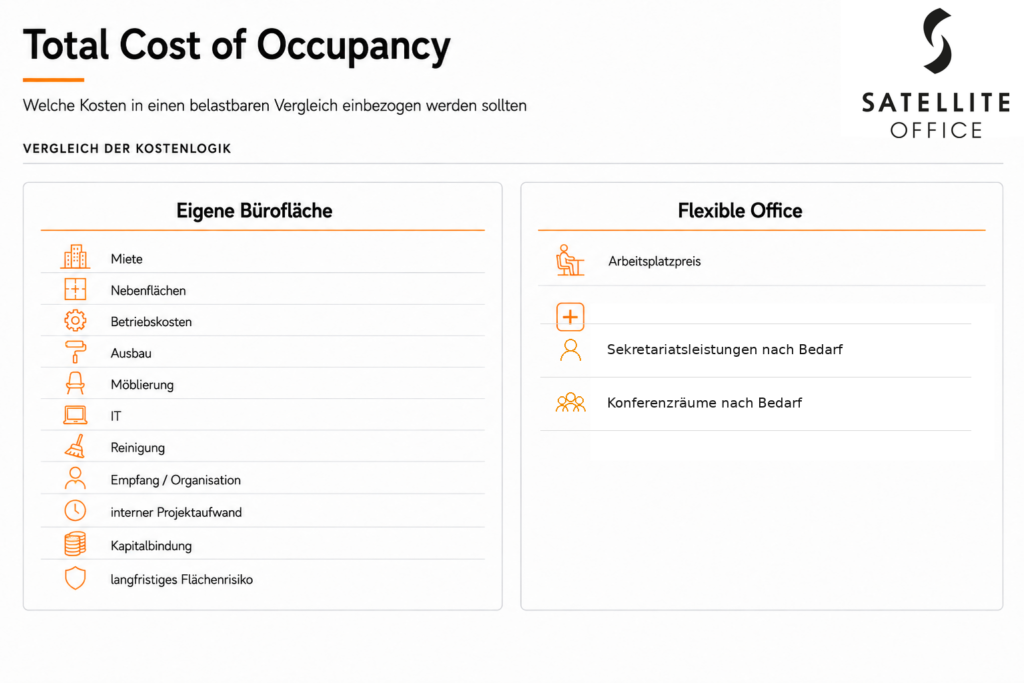
What are the total costs involved in getting a fully functional workspace up and running—and what risk does the company take on in the process?
Example: Six employees need an office in Munich
Let’s consider a new branch office with six employees in a central Munich location.
Dedicated office space
It’s not just six workstations that are needed. Depending on the situation, this may also include a meeting room, a reception or guest area, a kitchen, circulation areas, storage space, and room for future growth.
There are often several steps involved before moving in:
Search → Viewings → Negotiations → Planning → Renovation → Furnishing → IT → Service Providers → Move-in → Day-to-Day Operations
In addition to direct costs, this process ties up internal management resources.
Flexible Office
Six fully equipped workstations are reserved. The reception area, common areas, internet, and essential infrastructure are already in place. Meeting rooms and other services can be used or added as needed.
The nominal price per workstation may appear higher than a pro-rated net base rent. However, this does not represent the same scope of services.
Only a total cost of occupancy comparison reveals which model is more cost-effective in a specific case.
At what point does it make sense to have your own office?
There is no universal break-even point. Rents, renovation costs, floor plans, and service requirements vary too widely for that.
| More like a private space | More of a flexible office |
| Large, stable team | Small to medium-sized team |
| Long-term, predictable needs | Uncertain development |
| Long service life | Market entry or project duration |
| In-house infrastructure available | Infrastructure should not be built in-house |
| High need for customization | Quick deployment |
| Long-term commitment is not an issue | Flexibility has economic value |
The break-even point is therefore not just a matter of monthly rent, but also of capital, time, and risk.
What role does the office address play?
Not every company needs the most expensive location in a city.
For certain business models, however, the address can serve a specific purpose:
| Type of Business | Potential Benefits of a Prime Location |
| Law Firm | Trust, client perception, central accessibility |
| Private Equity / Family Office | Discretion and a prestigious setting |
| Consulting | Close ties to clients and decision-makers |
| International branch | A professional image when entering the market |
| Executive Office | Central Accessibility |
| Premium and luxury brands | Alignment between the brand and its environment |
A location like Königsallee, Opernplatz, or Maximilianstraße is therefore not automatically the right choice—but it’s not merely a matter of prestige either.
Where business partners, customers, investors, or job applicants regularly interact with a company, the office address can visibly support the desired positioning.
How much does a ready-to-use workspace in a premium location cost?
With flexible offices, costs are often calculated per workstation. Unlike a rent based purely on square meters, this may already include a significant portion of the necessary office infrastructure.
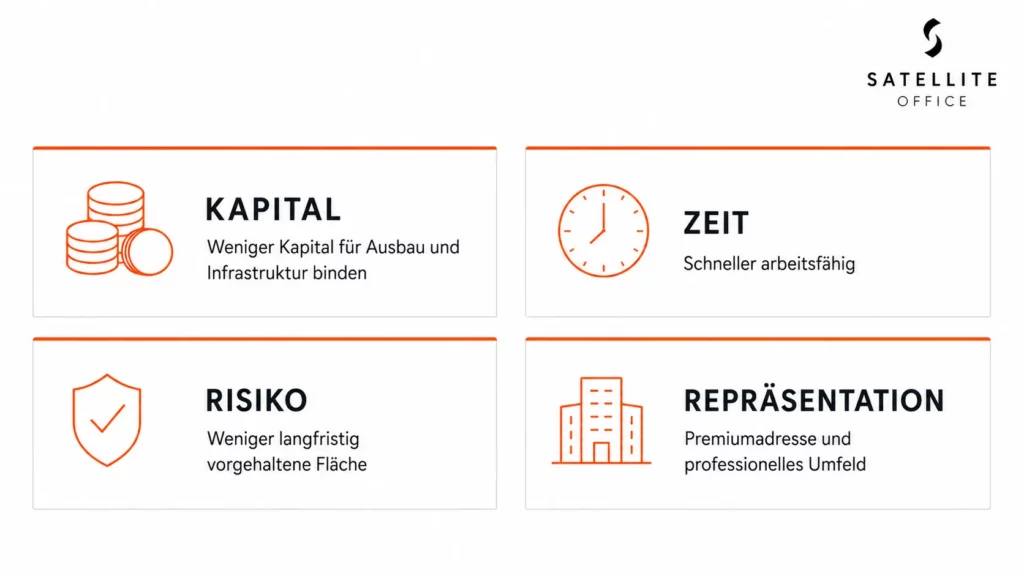
Using Satellite Office as an example, the economic benefits can be broken down into four areas:
Capital
Tie up less capital for renovations and infrastructure.
Ready-to-move-in offices, high-quality furnishings, technical infrastructure, and common areas reduce the investment and organizational burden that a company must bear on its own.
Time
A fully functional infrastructure without a lengthy setup process.
Especially for a new branch office, this can shorten the time between the decision on a location and the start of operations.
Risk
Less space held long-term.
The minimum term is three months. This means companies do not necessarily have to finance space today that they may not need for several years.
Reputation
A premium address and a professional work environment without having to maintain a full infrastructure on-site.
These include, among other things, a professional reception area, high-quality lounge and bistro areas, and a business or corporate address at the respective location.
Also included are essential operating and overhead costs, high-speed Internet, telephone infrastructure, office equipment, 24/7 access, and the use of the corresponding common areas. Additional services such as mail handling, telephone service, or a flat-rate beverage plan can be added as needed.
Sample Prices for High-Quality Flexible Offices
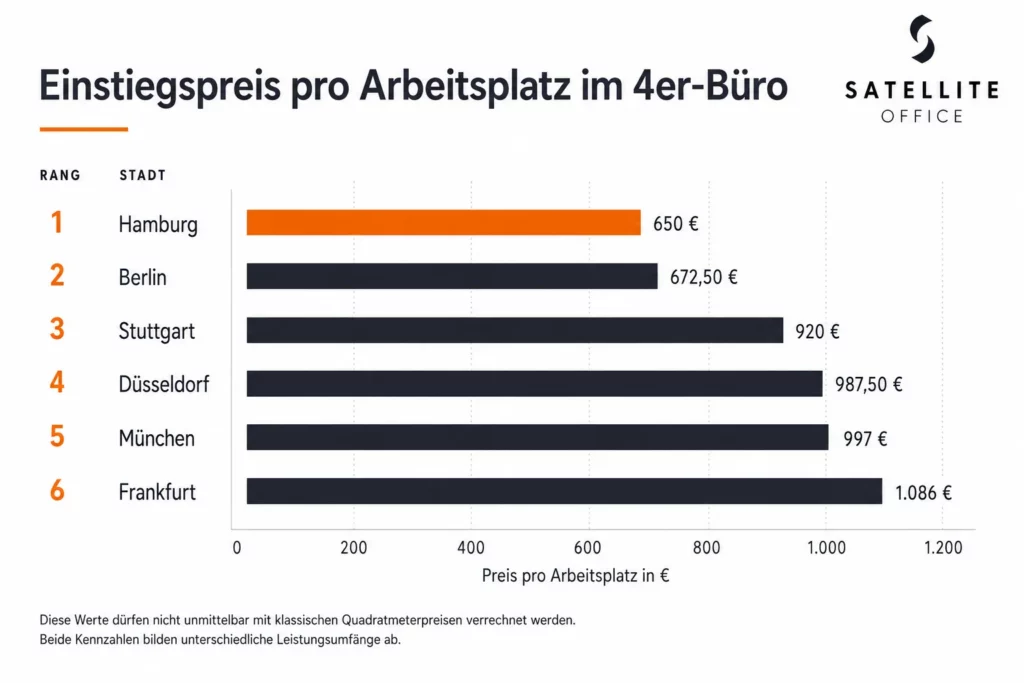
Using Satellite Office as an example, the following prices illustrate what a move-in-ready workspace at select premium locations might cost.
These prices apply to a 12-month contract term. The minimum term is three months. All prices are per workspace per month, net plus sales tax.
| City | 1-person office starting at | 2-person office starting at per AP | 4-person office starting at per workstation | 6–8-person office starting at per workstation |
| Berlin | 990 € | 760 € | 672.50 € | 690 € |
| Düsseldorf | 1,345 € | €987.50 | €987.50 | – |
| Frankfurt | 1,490 € | 1,150 € | €1,086 | 1,050 € |
| Hamburg | 1,100 € | 1,000 € | 650 € | – |
| Munich | 1,490 € | 1,075 € | 997 € | 784 € |
| Stuttgart | 1,380 € | €1,165 | 920 € | – |
| Cologne | No satellite office location | – | – | – |
Starting prices for a 12-month contract term; net, plus VAT; as of 2026. The starting prices are based on various available office and location configurations. Therefore, larger offices are not automatically less expensive per workstation.
Why prices vary significantly even within a single city
Flexible Office is not a standardized product either.
Location, architecture, work environment, service quality, and office size all influence the price.
Munich
| Location | Single-person office | 2-person office per AP | 4-person office per AP | 6–8 per AP |
| Ludwigpalais | 1,490 € | 1,075 € | 997 € | 784 € |
| Villa Goethe | €1,575 | €1,247 | 1,176 € | 1,027 € |
| MAXI14 | 1,970 € | €1,447 | €1,385 | 1,269 € |
Berlin
| Location | Single-person office | 2-person office per AP | 4-person office per AP |
| Kaiserliche Postdirektion | 990 € | 760 € | 672.50 € |
| Unter den Linden | €1,290 | 922 € | 697 € |
| KUD15 Gloria | 1,300 € | 995 € | 825 € |
| Haus Cumberland | 1,345 € | 1,075 € | 1,050 € |
The differences show that it’s not just the choice between a flexible office and dedicated space that matters. Even within the flexible office market, there are significant differences in location, architecture, work environment, service quality, and price.
Companies should compare three factors:
1. Location: Which city and micro-location are a good fit for customers, employees, and the business?
2. Space: How much dedicated space is actually needed, including meeting rooms, reception areas, circulation spaces, and reserve areas?
3. Model: Does it make sense to build and operate this infrastructure yourself in the long term—or is an existing flexible infrastructure more cost-effective?
A traditional office lease may be the right solution for large, stable organizations with long-term plans.
Flexible premium offices, on the other hand, become particularly attractive when a modest space requirement is combined with high standards for location, prestige, service, and flexibility.
A satellite office doesn’t have to be cost-effective simply because the nominal price per workstation is lower than that of any traditional office space. The advantage lies in situations where companies need a high-profile address and professional office infrastructure without wanting to build, finance, and organize their own complete office structure over the long term.
FAQ
Berlin, Düsseldorf, Frankfurt, Hamburg, Cologne, Munich, and Stuttgart are considered the seven established German office markets.
With a prime rent of around 62 euros per square meter, Munich has the highest price level among the seven markets surveyed. It is followed by Frankfurt at 56 euros and Berlin at around 51 euros.
That depends on the city, location, office size, and office model. For traditional office space, the effective cost per workstation must be calculated based on total square footage, rent, operating costs, furnishings, and infrastructure. Flexible office spaces are often priced directly per workstation.
In addition to the net rent, other costs may include operating and energy expenses, internet, cleaning, technical infrastructure, furnishings, facility management, and renovation and demolition costs.
This model may be particularly appealing to small and medium-sized teams, new branches, companies entering international markets, project teams, and companies with high standards regarding location and infrastructure.
A traditional office lease may be more cost-effective for large teams, when space requirements are stable over the long term, and when there is a strong desire for custom finishes.
Not necessarily. Both models have different cost structures. The key is a full-cost comparison that takes into account not only rent but also the required space, construction, amenities, ongoing operations, administrative costs, and contractual commitments.
Because vacant space is not evenly distributed across all building and location categories. Modern, high-quality office space in particularly sought-after downtown locations can remain scarce, even though there is a significant amount of vacant space in the overall market.
That depends on the business model. For companies with frequent customer contact—such as law firms, consulting firms, investment firms, or international representative offices—a prime central location can enhance accessibility, visibility, and positioning.
Methodology and Data Sources
The overall market figures for the seven cities are based on a standardized survey conducted for the first half of 2026. This largely eliminates differences in market definitions when making basic comparisons.
For downtown, CBD, and premium locations, current local market reports were also consulted. Since market areas, calculation methods, and definitions of the prime segment may vary, individual prime rents are presented as ranges, and downtown metrics are reported only where a reliable basis exists.
The traditional office rents shown are net rents in euros per square meter per month. Satellite office prices, on the other hand, are monthly net prices per workstation and already include significant portions of furnishings, infrastructure, operational services, and other services. The two metrics are therefore not directly comparable.
Market data as of: the first half of the year and the second quarter of 2026, respectively.
Stay up to date
Subscribe to our newsletter

Subscribe to our free newsletter and receive regular updates from the world of Satellite Offices. Find out all about exciting events, innovative products, special offers and the latest developments at our locations.