Coworking Spaces for Startups in Munich: What Founders Should Look For


A startup needs space for new ideas—but it doesn’t necessarily need its own office right from the start. Especially during the startup and growth phases, team sizes, work models, and financial resources often change within a matter of months. Long-term leases can be just as much of a hindrance as workspaces that don’t allow for focused collaboration.
Coworking spaces offer startups in Munich a flexible alternative to traditional offices. But not every provider is a good fit for every company. In addition to cost, factors such as quiet workspaces, professional meeting rooms, location, and the ability to grow alongside your team play a decisive role.
What should founders look for when making their choice? And when is a coworking space the right solution?
Why Coworking Is Attractive to Startups in Munich
Munich is one of Germany’s most important startup hubs. According to the Munich Economic Development Agency, more than 1,700 active startups are based in the city. The Munich Chamber of Commerce and Industry’s (IHK München) Startup & Scaleup Monitor 2026 reports a total of 290 new startup launches for the year 2025, representing a 43 percent increase over the previous year.
The region is also attractive to investors: According to the Startup Association, approximately 2.7 billion euros in investments flowed into startups in the Munich region in 2025.
This creates an attractive environment for young companies, combining research, established businesses, talent, and investors. At the same time, the question of finding a suitable work environment arises early on.
A traditional office often requires long-term commitments and investments in furnishings, technology, and organization. Coworking, on the other hand, offers a more flexible way to access professional workspaces.
With its coworking spaces in Munich, Satellite Office, for example, offers flexible workspace models that combine a quiet work environment with professional service and a high-quality business setting.
What matters most here is not so much whether a company wants to use coworking spaces in principle. Far more important is the question of which work model suits its current stage of development and what prospects the location offers for further growth.
What should startups look for in a coworking space?
1. Flexible terms and workspace models
A startup with two founders has different needs than a company that has just completed its first round of funding and is hiring more employees.
A suitable coworking space should therefore offer different usage models. For occasional days in the office, flexible daily bookings can be a good option. Those who work in the office regularly may benefit more from a membership or a dedicated workspace.
Before signing a contract, founders should check the contract terms, how additional workstations can be booked, and whether it’s possible to switch between different models.
Not every short contract term automatically means maximum flexibility. The key factor is whether the chosen model can be adapted to changing team structures.
2. Transparent Costs and Predictable Expenses
Every euro counts, especially in the startup phase. However, it’s not enough to compare coworking with a traditional office based solely on monthly workspace costs.
Renting your own office entails additional expenses for furniture, internet, electricity, cleaning, insurance, and day-to-day office operations. On top of that, there may be security deposits as well as the time required for setting up and organizing the space.
A professional coworking space bundles many of these services. However, which services are included in the price and which are billed separately depends on the specific provider and pricing plan.
So, how much does a job actually cost?
With Satellite Office’s office cost comparison calculator, companies can compare different office models. The calculator compares a conventional office with a fully equipped Satellite Office location, as well as a hybrid combination of an office and a coworking space. In addition to rent, it takes into account factors such as furnishings, operating expenses, and organizational costs.
For startups, this comparison provides helpful guidance on the costs that are often overlooked when deciding to rent an office.
Those who wish to use only flexible coworking day passes should calculate the costs separately based on the actual number of days used and the pricing terms.
3. Quiet spaces and places to retreat for focused work
Open workspaces and a vibrant community are hallmarks of traditional coworking. For many founders, the opportunity to exchange ideas with other companies is a major benefit.
However, the day-to-day work of a startup also requires periods when undisturbed concentration is the priority.
Whether it’s software development, product strategy, financial planning, or preparing an investor presentation: not every task is suited for an open communal space.
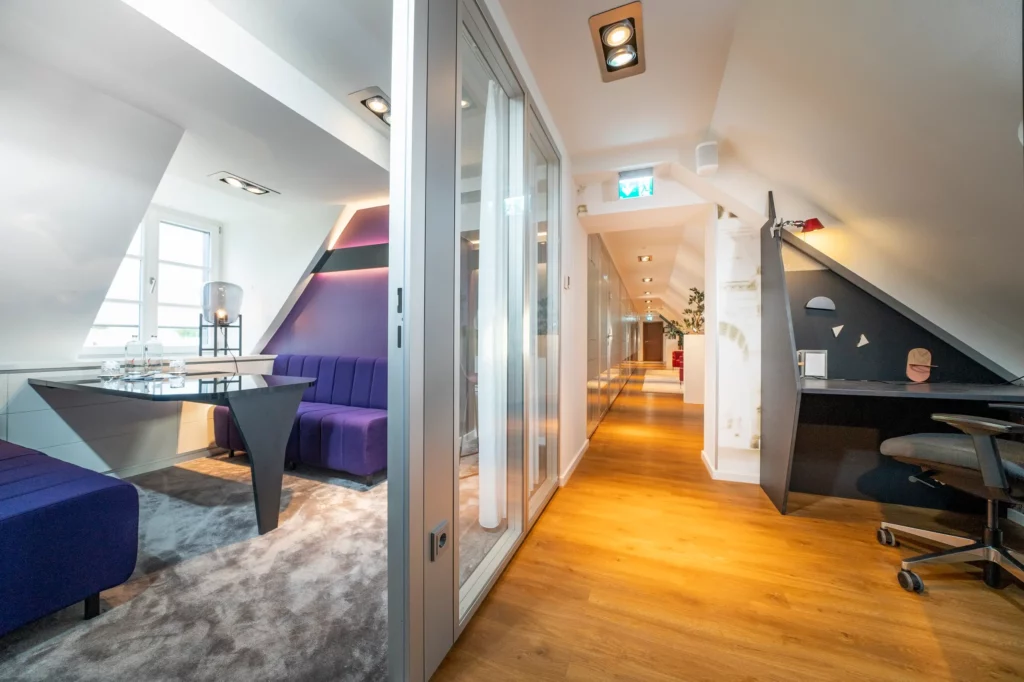
A good coworking space should therefore offer a variety of work environments. These include quiet workspaces, soundproofed phone booths, and separate meeting rooms.
Especially when it comes to confidential projects, it’s crucial that sensitive conversations don’t have to take place in the communal area.
The quality of a coworking space is therefore not determined solely by its furnishings, but also by how well it combines focused work with personal interaction.
4. Professional meeting rooms for clients and investors
For startups, meetings with potential investors, customers, and strategic partners are important milestones in the company’s development.
A pitch, contract negotiations, or a discussion about a funding round place different demands on the work environment than an internal team meeting.
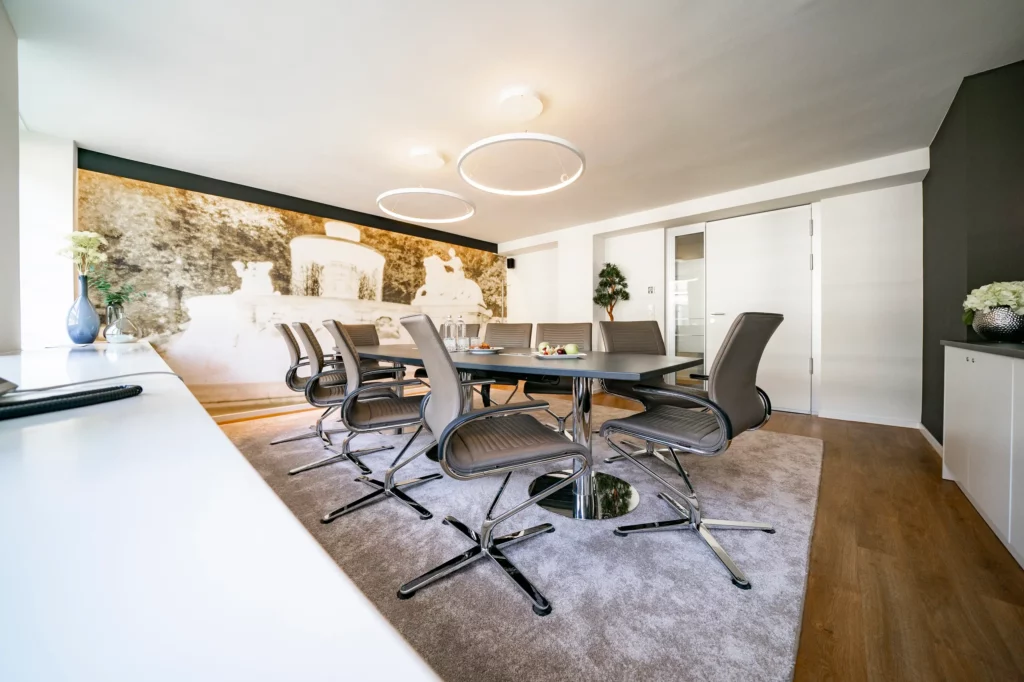
Suitable conference rooms should offer sufficient privacy, reliable presentation technology, good acoustics, and professional organization.
Stable technical equipment is particularly important for hybrid meetings with international business partners.
A coworking space with meeting rooms that can be booked separately enables young companies to host even high-stakes business meetings without having to rent their own conference space on a permanent basis.
5. Central location and easy access
The choice of location affects more than just the daily commute. Accessibility also plays an important role for job applicants, business partners, and customers.
In Munich, startups should therefore pay particular attention to public transportation connections, proximity to the main train station, and access to key business partners.
For internationally oriented companies, a central, prestigious business address can also be appealing.
That said, not every coworking space needs to be located in the middle of a bustling business street. Especially for focused work, a quiet location with good transportation access may be the better choice.
6. Opportunities for the team to grow
A common mistake in workplace planning is to focus exclusively on current needs.
A startup that currently has two employees may experience significant growth following a funding round or a major client contract.
As the team grows, requirements often change as well: shared workspaces, confidential coordination, and regular in-person presence become more important.
That’s why coworking providers that offer private offices and team offices in Munich in addition to flexible workspaces are particularly interesting.
This allows the workplace strategy to evolve without a company necessarily having to look for a completely new location with every step of its growth. Whether such a move is possible depends on the availability of suitable space.
7. Network and Professional Environment
Coworking can help you make new business contacts. Interacting with other companies, participating in joint events, and receiving personal recommendations create opportunities that might not arise as often in your own office.
However, the target audiences of coworking providers vary considerably.
Some coworking spaces focus on founder programs and a young startup community. Others cater more to established companies, consulting firms, law firms, and international business clients.
Which environment makes the most sense depends on your own goals.
A startup in the early idea phase can benefit greatly from mentoring and direct contact with other founders. For startups that have already secured funding and regularly host clients or investors, a quiet business workspace with professional services may be the better choice.
A strong network is an advantage. However, it should not be the only selection criterion.
How many coworking spaces does a startup really need?
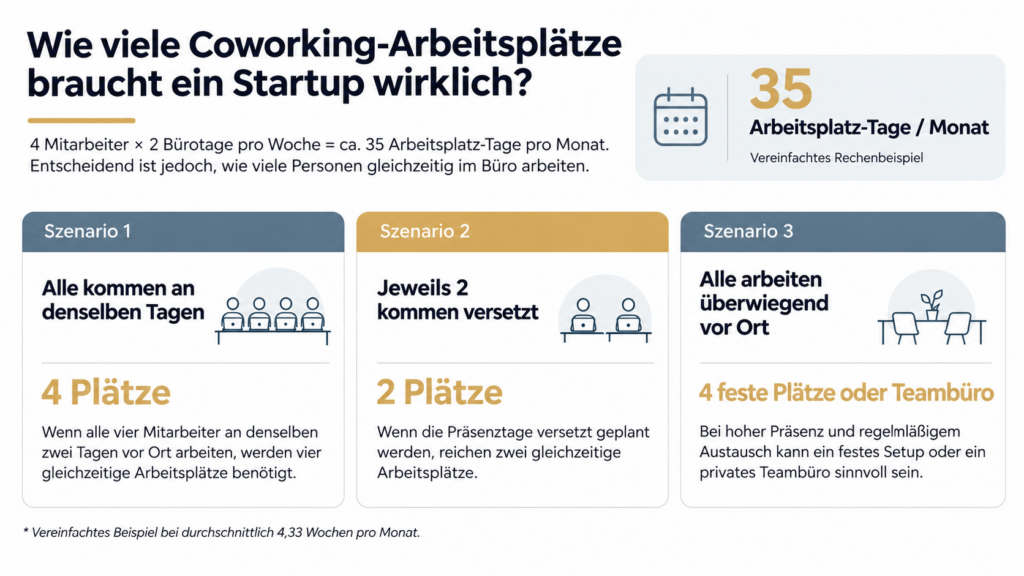
When planning workspaces, the number of employees is often equated with the number of permanent desks needed. In hybrid work models, this can lead to unnecessary costs.
Here’s an example to illustrate the difference:
A Munich-based startup employs four people. Each person works in the office an average of two days per week.
This amounts to approximately 35 workdays per month.
However, what matters most is how this presence is distributed.
| Work Model | Simultaneous Seats Required | Possible Solution |
| All four employees come in on the same two days | 4 | Flexible workstations or dedicated team workstations |
| Two employees each come in on different days | 2 | Coworking with predictable space availability |
| All four work primarily on-site | 4 | Dedicated workstations or a private team office |
Simplified calculation example based on an average of 4.33 weeks per month. Actual suitability depends on the booking model, availability, and team organization.
The example shows that it is not just the size of a team that determines workspace requirements. At least as important are the actual days spent in the office and how often all employees need to work together at the same time.
A startup that primarily coordinates its work digitally may need fewer permanently assigned desks. For teams that regularly meet in person, however, a shared office can be a good option.
Which coworking model is best suited for each stage of a startup?
The ideal work environment evolves as the company grows.
Startup Phase: Stay Flexible
For individual founders and small teams, flexible coworking spaces are often a cost-effective solution. They provide a professional workspace without requiring a long-term office commitment.
Growth phase: Facilitating collaboration
As the first employees join, regular team days, meeting spaces, and reliable workspaces become increasingly important. A membership or a combination of fixed and flexible workspaces may be suitable for this.
Growth phase: creating more privacy
As daily coordination, confidential discussions, and fixed team structures become more common, having a dedicated office often becomes more appealing. A private team office offers greater control over the work environment while still being part of a professionally managed workspace concept.
For startups, therefore, a location is particularly appealing if it not only facilitates getting started but also accommodates different work models for the next phases of development.
Villa Goethe: Coworking for Startups in Munich with Room to Grow
With Villa Goethe, Satellite Office is developing a business-class workspace at Goethestraße 54 that offers entrepreneurs and growing companies an attractive combination of flexible workspaces and professional office infrastructure.
The location is in Ludwigsvorstadt, near Theresienwiese. The historic building combines classic architecture with Satellite Office’s pureSilent® space concept, which is designed to promote tranquility, feature high-quality materials, and facilitate focused work.
The planned offering includes coworking spaces, 51 private offices, and flexibly bookable conference facilities.
This opens up several usage scenarios for startups:
- Flexible Options: Coworking spaces that can be used on a daily basis or with a membership.
- Focused collaboration: Private offices, silent cubes, and air-conditioned phone booths for work and phone calls that require a quiet environment.
- Professional business meetings: Conference rooms equipped with modern video technology and capacity for meetings of up to 20 people.
- Growth prospects: A variety of office sizes makes it possible to find a suitable solution within the workspace offering, even as space requirements increase.
The planned work environment is complemented by a personalized, multilingual reception desk, office assistance, a fireplace lounge, and two terraces.
This combination may be particularly appealing to young companies that regularly collaborate with discerning business clients, international partners, or potential investors.
Villa Goethe should not be viewed as a traditional startup incubator. Rather, its focus is on providing a high-quality, quiet work environment with professional infrastructure.
For startups that have already gone through their initial growth phases or that value discretion and a prestigious business environment from the very beginning, this can be a suitable alternative to more community-oriented coworking concepts.
For more information about the planned facilities and employment opportunities, please visit the Villa Goethe in Munich website.
Checklist: How Startups Can Find the Right Coworking Space
Before deciding on a coworking space, founders should define their company’s requirements as specifically as possible.
- Flexibility: Does the contract model fit the company’s current stage?
- Costs: What services are included in the price, and what additional expenses will arise?
- Work Environment: Are there enough quiet workspaces and places to retreat to?
- Meeting Rooms: Can clients, business partners, and investors be received in a professional manner?
- Location: Is the location easily accessible for employees and business partners?
- Growth: Is it possible to use additional workstations or rent private offices?
- Surroundings: Does the coworking space’s focus align with the company and its business needs?
A personal tour helps you identify differences that aren’t always apparent in photos or performance overviews. In particular, the acoustics, the actual work atmosphere, and the quality of the reception area can be better assessed in person.
Frequently Asked Questions About Coworking for Startups in Munich
Coworking can offer economic advantages, especially for small teams and those who use the space irregularly. It often eliminates the need for large upfront investments in furnishings and infrastructure. Whether coworking is actually more cost-effective depends on team size, frequency of use, the contract model, and the services included.
Conclusion: The right coworking space grows along with the company
For startups in Munich, coworking is particularly appealing when it combines flexibility, financial predictability, and a professional work environment.
However, current needs alone shouldn’t be the deciding factor. A good workspace enables focused work, provides suitable rooms for important business meetings, and opens up opportunities for future growth.
Those who consider these requirements early on are not only deciding on their next workspace but also laying a solid foundation for the company’s future development.
Stay up to date
Subscribe to our newsletter

Subscribe to our free newsletter and receive regular updates from the world of Satellite Offices. Find out all about exciting events, innovative products, special offers and the latest developments at our locations.