Henry in the mirror – why time disappears and how we prevent our lives from just “existing for a long time”

 5. March 2026
 Reading time: 5 Minutes
It is 1933.
A boy is playing on a street in Connecticut. A cyclist overlooks him. A fall. Unconsciousness.
The boy’s name is Henry Molaison.
Years later, he became the most tragic footnote in neuroscience. At the age of 27, he underwent surgery for severe epilepsy. The seizures disappear. But something fundamental disappears with them: Henry can no longer form new memories.
He lives another 55 years.
Without being able to remember them.
His psychiatrist visits him every day. Builds trust over decades.
For Henry, it’s the first meeting every time.
Perhaps the most disturbing detail:
Henry stands in front of the mirror in the morning – and is startled. Why does the man there look so old?
He didn’t realize that time had passed.
Because it has left no traces.
Why time accelerates
Of course, Henry is an extreme case. But many people know the basic feeling: You look back – and seriously wonder where the last ten years have gone.
One explanation is provided by what psychologists call “Janet’s Law”.
At five years old, one year is 20 percent of your life so far.
At fifty, it’s two percent.
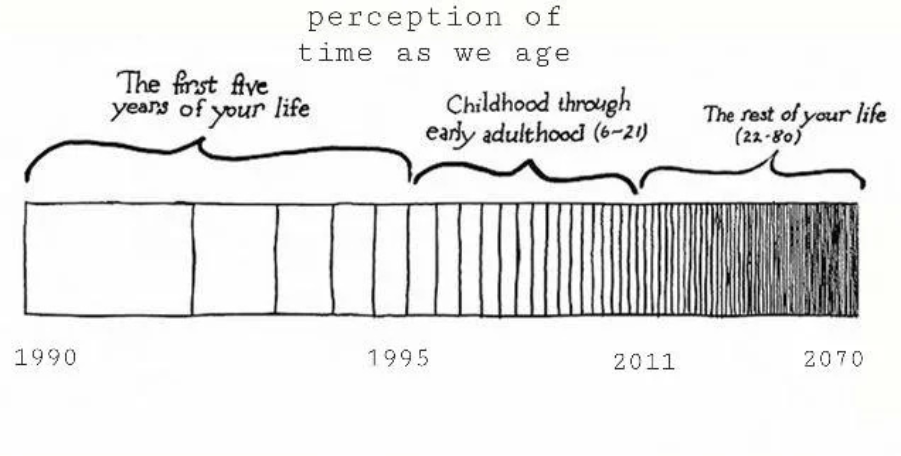
According to this logic, it feels like you have already experienced half of your perceived life before you turn twenty.
The summer of a five-year-old feels as long as the entire decade between 40 and 50 for a forty-year-old.
But it goes even deeper.
The three dimensions of time
Time is not one-dimensional.
Time is objective. Sixty minutes remain sixty minutes.
Experience time is subjective. An hour in a traffic jam stretches. An hour in the flow shrinks.
Memory time decides what remains.
When people say that life goes by quickly, they usually mean:
They don’t remember enough of it.
Henry had 2.6 billion seconds of time.
But almost zero seconds memory time.
And what about us?
We don’t forget 55 years in a row.
But we lose weeks, months, sometimes years in the fog of routine.
Seneca was right – and he was uncomfortable
The Roman philosopher Seneca wrote in “De brevitate vitae”:
“Don’t think a person has lived a long time just because he has gray hair and wrinkles. He has not lived long – he has only existed long.”
That’s not a wellness quote. It’s a slap in the face.
You can turn eighty – and still only have lived consciously for thirty years.
So the exciting question is not:
How do we extend our lives?
But rather:
How do we prevent ourselves from existing for too long?
Three principles against the disappearance of time
1. search for novelty
How many days from the last year can you name clearly? Ten? Twenty?
That’s maybe five percent of the year. The rest has disappeared in Henry’s mirror.
Why do we remember certain days?
Because something was new.
The first day at work. An important conversation. A courageous decision.
Novelty is saved. Routine is compressed.
This does not mean putting on a spectacular show every day. But it does mean consciously breaking out of patterns. A different format. A change of perspective. A conversation with someone who challenges you.
Novelty is not a luxury. It is memory care.
2. think in stories
We consume hundreds of pieces of content every day. Hardly any of it stays.
Why do we remember a movie from ten years ago – but not the 300 posts from yesterday?
Because a good story has structure. Tension. Development. Turning points.
Life should not seem like an endless social media feed.
It needs chapters.
The writer Dostoyevsky once asked:
“But how can you live and not have a story to tell?”
A radical question.
If your year is structured like a good book – with decisions, developments and consequences – it will feel longer.
A simple decision rule is:
What makes the better story?
Even if it goes wrong – at least your plot will be denser.
3. marvel at the small – Ichigo Ichie
Not every day is exceptional. And that’s okay.
In Japan there is a concept called Ichigo Ichie – “This moment only exists once”.
Today’s meeting will never take place in exactly the same way again.
These people will never be exactly the same age again.
The light falls through the window differently today than yesterday.
If you consciously perceive details, you subjectively slow down time.
Your morning coffee is never the same coffee.
The temperature is slightly different. Your condition is different. The world outside is different.
Time becomes denser when attention becomes more precise.
And now to work – honestly and without romance
We spend an enormous part of our lives at work.
If this time takes place on autopilot, it disappears.
Not from the watch. But from our lives.
Functional rooms create functional days.
Distraction, noise, interchangeability – the brain stores little of it.
A well-designed workspace, on the other hand, changes experience time.
When concentration is possible, depth is created.
When aesthetics are taken seriously, appreciation arises.
When conversations have substance, turning points arise.
Suddenly you remember.
Not to every e-mail.
But to the conclusion of the contract after intensive negotiations.
To the strategy meeting in a quiet atmosphere.
To the idea that has grown in a clear space.
Spaces shape time.
And time shapes memory.
A look in the mirror
Henry stood in front of the mirror and didn’t understand why the man there was old.
We have another privilege:
We can decide how dense our years become.
If we only react, only function, only work, then we may exist for a long time.
When we consciously create, decide, perceive – then we live.
Perhaps in the end it’s not about collecting more years.
It’s about being able to say when we look in the mirror one day:
I didn’t just exist for a long time. I have lived.
And perhaps some of these stories were written in a space that was created precisely for this purpose.
This article was strongly inspired by the Growth Newsletter of the Demand Curve Agency.
Stay up to date
Subscribe to our newsletter

Subscribe to our free newsletter and receive regular updates from the world of Satellite Offices. Find out all about exciting events, innovative products, special offers and the latest developments at our locations.